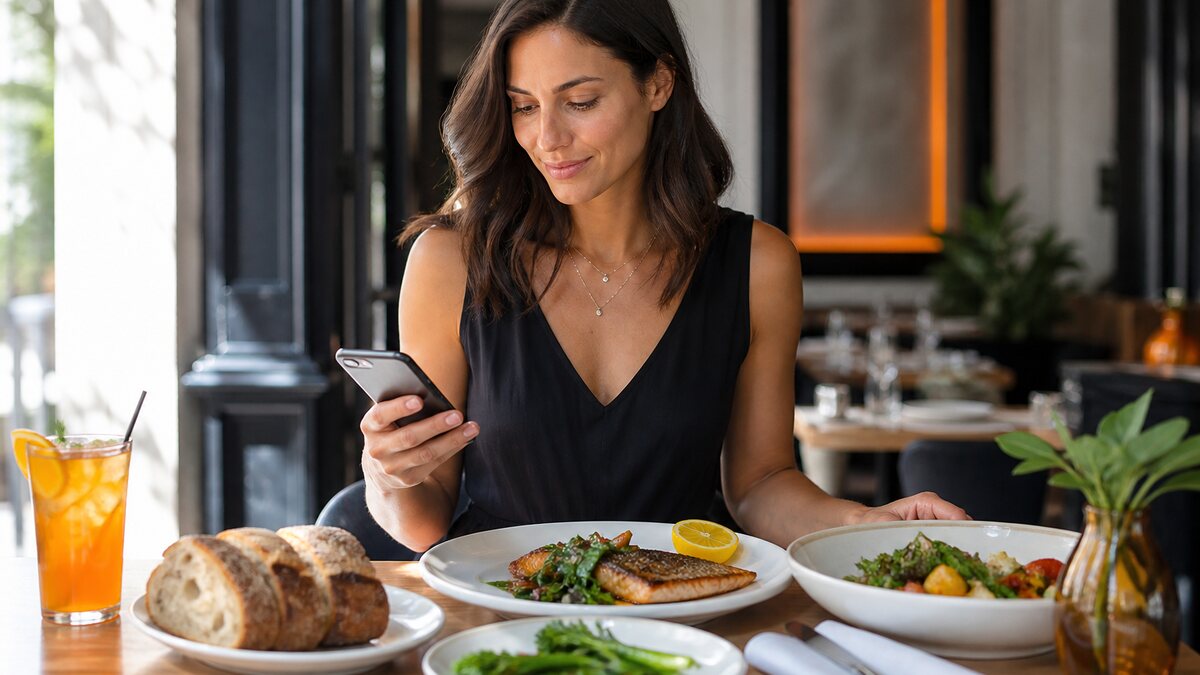
Counting calories while eating out does not require arriving with a food scale or choosing the plainest item. The useful goal is to preserve enough structure to understand your meal while leaving room for hospitality, appetite, and imperfect information.
Decide what matters before you order
Look at the menu in advance when convenient. Choose the part of the meal you care about most: perhaps the main course, dessert, cocktails, or shared bread. You do not need to minimize every course. Deciding your priorities prevents a series of automatic additions from turning into a meal you did not actually want.
If the restaurant publishes nutrition, verify the exact size and included sides. Otherwise, shortlist dishes whose components are reasonably clear. Grilled protein with potatoes and vegetables is easier to interpret than a heavily dressed mixed platter, although either can fit your plan.
Do not “save” for dinner by ignoring strong hunger all day. Arriving ravenous can make deliberate ordering and attention to fullness harder. Eat in the pattern that normally supports your energy and appetite.
Ask questions that change the decision
You do not need to interrogate the server about every gram. A few practical questions are enough:
- Which side comes with the dish, and can it be changed?
- Is the sauce mixed through or served separately?
- Is the listed weight before or after cooking?
- Is this plate intended for one person or for sharing?
- Does the nutrition listing include dressing and toppings?
Requesting dressing on the side, swapping a side, or boxing part of a large serving are options—not rules. Make changes that improve the meal for you rather than turning dinner into a test of restraint.
Track the whole occasion
Logs often capture the main course while missing the pieces eaten around it: bread with butter, a few shared fries, tasting someone else’s dessert, and a drink refill. These do not need obsessive accounting, but they are part of the occasion.
Use a simple timeline: before the main, the main plate, and after the main. Record meaningful items in each phase. For a shared dish, estimate your fraction from the number of diners and adjust if your share was clearly smaller or larger.
Use leftovers as information
The menu portion is not automatically your portion. If you stop after roughly two-thirds, log roughly two-thirds. A quick photo before and after can support your memory. Ask for a box while the remaining amount is still obvious if you want to prevent casual picking.
Choose a sensible level of detail
For a chain item with official data, one entry plus modifications may be enough. For an independent restaurant, break the meal into protein, starch, vegetables, sauces, and extras. The method in how to estimate restaurant calories explains that process.
Use ranges when preparation is unclear. A richer sauce or generous oil pour can change the estimate, so a narrow exact number is misleading. Review weekly patterns rather than treating one uncertain dinner as a verdict on progress.
Trayly’s restaurant calorie tracker can turn a menu or meal description into a reviewable starting estimate. Correct the side, amount eaten, and missing extras. It is an aid to logging, not a direct measurement of the kitchen.
A calm restaurant routine
- Preview the menu and pick your priority.
- Check official nutrition when available.
- Order the dish you want, making only useful modifications.
- Notice shared food, drinks, sauces, and the amount left.
- Log soon after eating, review assumptions, and move on.
Restaurant meals are variable by nature. Successful tracking makes that variability manageable; it does not eliminate it. For practical menu ideas, see how to order healthier fast food. The best routine is one you can use at a quick lunch, a birthday dinner, and an unplanned evening without making the company at the table secondary.